Essay · Sep 15, 2026 · 5 min
Do Not Investigate Here
On the almost invisible transformation that occurs when a method for interrogating reality becomes a claim about what reality is allowed to contain.
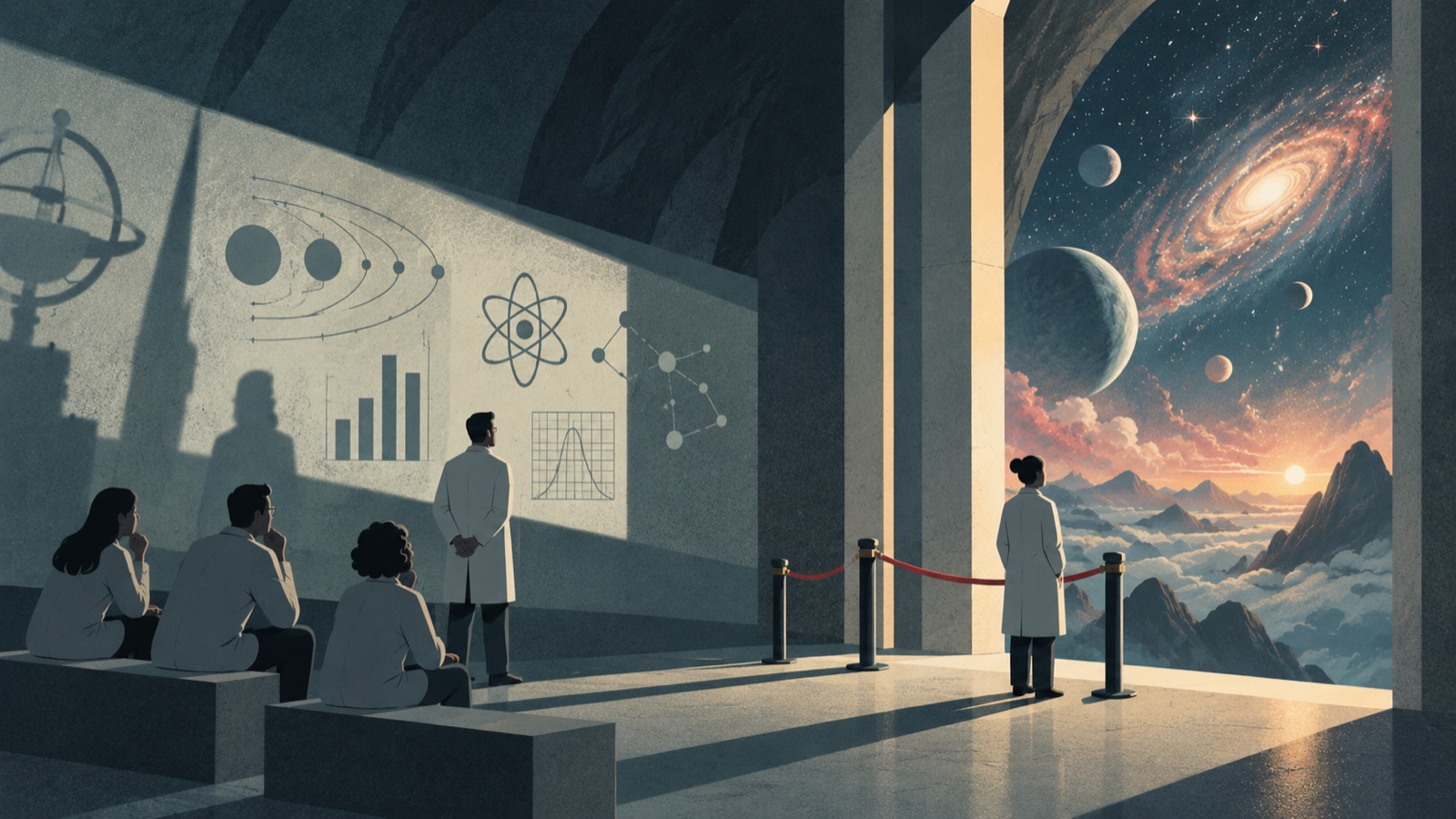
I have become increasingly suspicious of the phrase scientific worldview.
What bothers me is the almost invisible transformation that occurs when a method for interrogating reality becomes a claim about what reality is allowed to contain.
Before you scorn and label me as a new age hippie, bear with me and see my point:
Science is extraordinarily powerful at answering certain kinds of questions. But the answers produced by science are not themselves the scientific method. The Standard Model and the physicochemical properties of lactococcal bacteriocins are, like all other contents of the scientific pursuit, exactly that: products of particular scientific inquiries conducted at particular moments in history.
This distinction seems trivial until we encounter something like astrology.
Say the word astrology in an educated room and an unusual thing happens. Before any particular claim has been formulated, we already know its epistemic status:
Pseudoscience.
Case closed.
But what, exactly, have we closed?
Karl Popper famously tried to distinguish science from non-science through falsifiability. A scientific theory, on his account, must expose itself to observations that could prove it wrong. Science advances not because we accumulate confirmations but because our theories survive serious and rigorous attempts at refutation. Importantly, Popper did not equate non-scientific with meaningless. He explicitly recognized that metaphysical ideas could be meaningful and that ideas could migrate, eventually, from metaphysics into testable science.
That distinction has largely disappeared from popular scientific discourse. But, why?
We often use pseudoscientific not to describe the methodological behavior of a particular theory, but as an ontological label; what allows us to discern from the valid contents of science, and the a priori quarantined content.
DO NOT INVESTIGATE HERE!
Astrology is an unusually revealing example because its history does not fit the clean story we usually tell about it.
For centuries astrology was not some fringe practice conducted outside educated inquiry. It was taught alongside astronomy, mathematics, medicine, and natural philosophy in major European universities. Historians of science now describe its disappearance from legitimate intellectual life as a long process extending through the 17th and 18th centuries, involving empirical problems but also changes in universities, medicine, religion, politics, intellectual fashion, and the conceptual structure of natural philosophy itself.
This does not imply that astrology was correct, but it shows the history of the boundary around legitimate knowledge.
Astrology has indeed been scientifically tested. Shawn Carlson's famous 1985 Nature experiment used double-blind procedures to test whether astrologers could use natal charts to accurately describe subjects' personalities. The results did not support the tested astrological hypotheses.
That is exactly what science should do.
But notice what the experiment actually established. It did not experimentally evaluate every proposition that has existed under the name astrology during several thousand years of intellectual history. It tested a considerably narrower proposition concerning natal charts and personality description.
There is an enormous logical distance between:
"This particular astrological claim failed under controlled testing"
And:
"Astrology is false"
This does not mean that we should resurrect every abandoned doctrine indefinitely. Research resources are finite, and failed research programs deserve declining confidence. Many astrological claims have accumulated substantial negative evidence.
But there is a subtle epistemic danger in allowing low prior probability to mutate into forbidden subject matter.
Because we go from saying:
"Make a claim. Tell me what would falsify it. Let us test it."
To saying:
"Claims belonging to this historical category are not candidates for investigation"
And:
"Claims belonging to this category are false."
Popper himself gives us reasons to be suspicious of that move.
Thomas Kuhn complicates the situation further. Kuhn argued that actual science does not spend most of its time trying to destroy its fundamental theories. Most scientists practice what he called normal science: working inside an accepted paradigm, solving the puzzles that paradigm makes visible. An anomaly does not normally destroy a theory. Scientists often tolerate anomalies for years or decades while trying to understand them.
Curiously, Kuhn specifically discussed astrology. He argued that astronomy generated research puzzles when predictions failed, whereas failures in astrology did not produce a productive tradition of puzzle-solving and theoretical revision. On that basis he regarded astrology as non-scientific. Popper objected to Kuhn's characterization. Two of the twentieth century's most important philosophers of science could agree that astrology was not successful science while disagreeing about why. The boundary was already less obvious than the label makes it appear.
Paul Feyerabend pushed the problem much further. After beginning as a Popperian, he came to argue that the history of successful science simply does not reveal a single universal method faithfully followed by its greatest practitioners. Scientific practice is heterogeneous, opportunistic and historically contingent. The contemporary philosophy of scientific pluralism similarly recognizes that real sciences employ diverse methods, conceptual schemes, ontologies and standards of explanation.
We often reconstruct the history of science backwards. The theories that survived become Science. The theories that disappeared become superstition. Then we imagine that the boundary had always been obvious.
Heidegger's critique of modern technological thinking was not an argument against scientific knowledge. It was an argument against allowing one particular manner of encountering reality to become our only manner of encountering reality.
In what he called technological enframing, things increasingly appear to us in terms of what can be ordered, measured, manipulated, predicted and made available. The danger is not that this perspective is false. It is extraordinarily effective.
The danger is forgetting that it is a perspective.
Scientific thinking becomes scientism at precisely the point where we mistake the success of that answer for proof that it is the only meaningful question. Science should not be understood as a growing territory surrounded by walls, with Physics, Chemistry and Biology safely inside and Astrology, Mysticism and Metaphysics permanently exiled outside.
It is better understood as a practice. Nothing becomes scientific merely by being accepted by scientists, and nothing becomes immune from scientific interrogation merely because scientists have learned to laugh at it.